

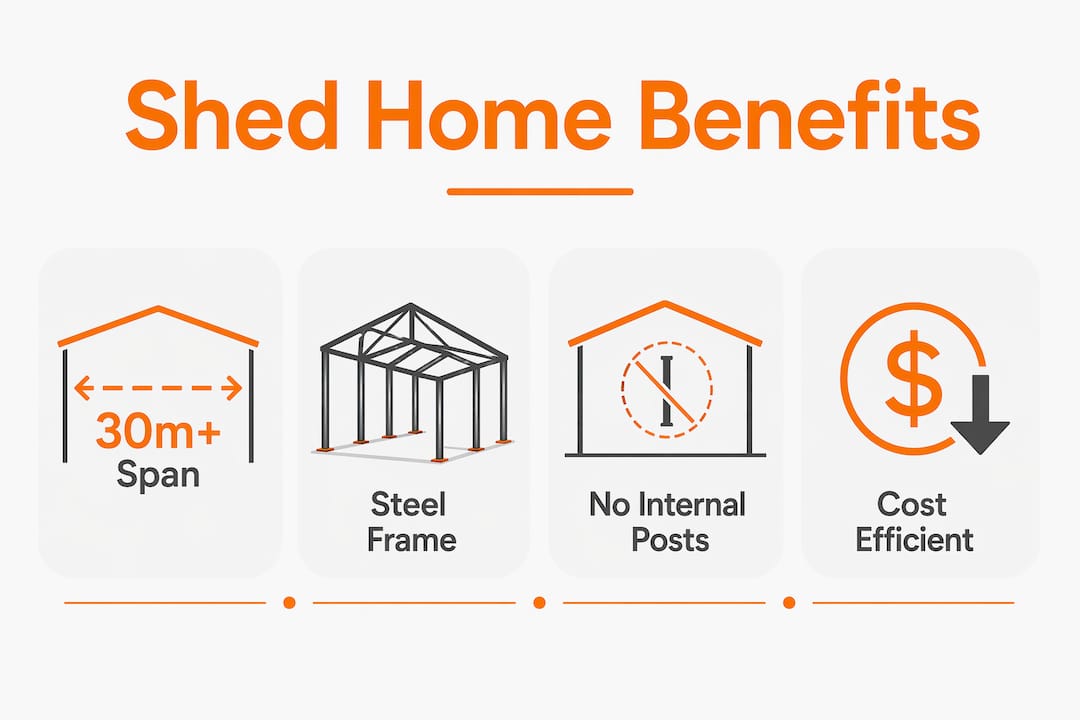
A large span shed home uses engineered steel portal frames to clear-span 10 metres or more without any internal columns. No posts in the middle of your living room. No structural walls dictating where your kitchen goes. Just wide, open floor space that you can lay out however you want.
What is a large span shed home and how is it defined?
A large span structure is defined by the construction industry as any building achieving a clear span of 30 metres or more without internal columns. That single engineering fact changes everything about how a home can be designed and used. Where a conventional house is divided by load-bearing walls every few metres, a large span shed home presents an open interior that the owner configures entirely to their own requirements.
The term “shed home” is informal but widely used in Australia to describe a Class 1A residential dwelling built using a steel kit frame originally derived from agricultural or industrial shed engineering. The structural logic is the same: a rigid steel portal frame carries all loads through the columns and rafters to the footings, with no internal walls required for structural support. This is the cold, hard intellectual comfort that steel construction offers. The geometry does the work, not the walls.
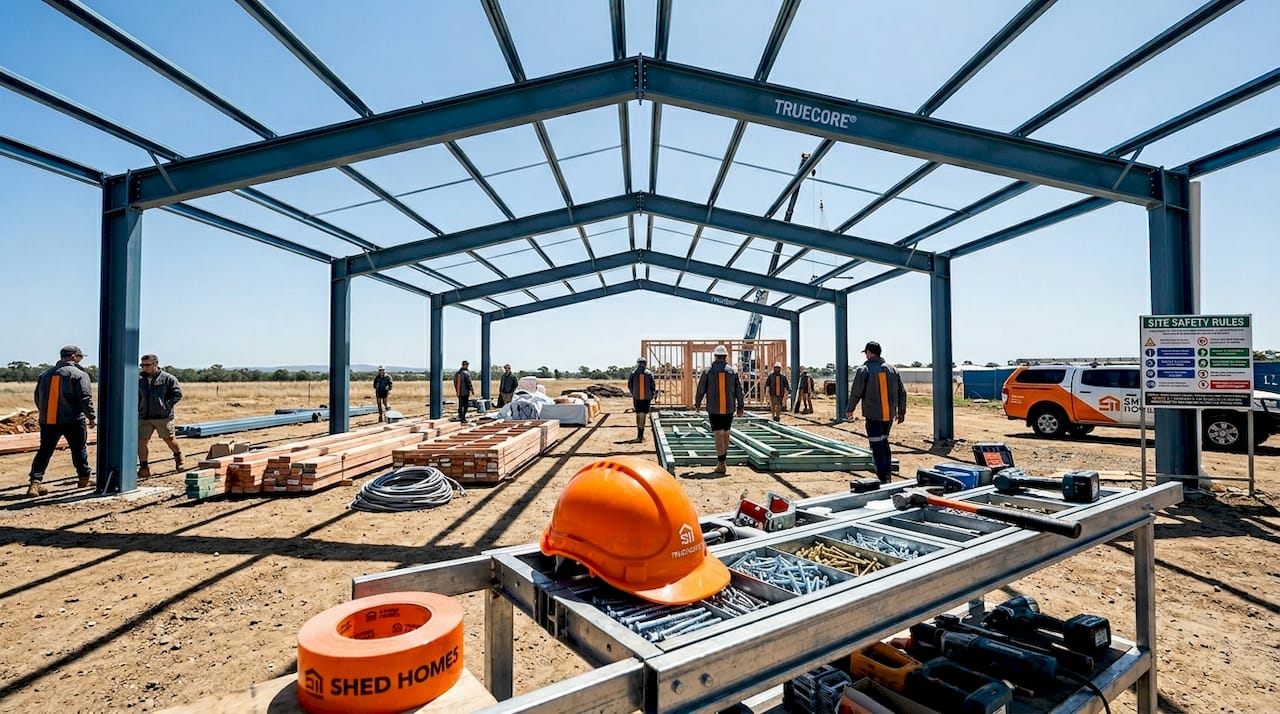
COLORBOND® steel cladding and TRUECORE® steel framing are the two material names you will encounter most often in this market. COLORBOND® provides the external skin, rated for Australian weather conditions from tropical Queensland to alpine Victoria. TRUECORE® forms the internal stud framing for walls and ceilings, replacing timber with a dimensionally stable, termite-proof alternative. Together, they define the premium end of the Australian steel kit home sector in 2026.
What are the structural features and benefits of shed homes?
The defining structural feature of a large span shed home is the clear-span portal frame. Steel rafters and columns form a rigid triangle that transfers all roof and wind loads directly to the slab, bypassing any need for internal walls to carry weight. Avoiding internal columns fundamentally alters not just available space but room layout, circulation, and storage possibilities across the entire floor plate.
The practical benefits of this design are substantial:
- Open plan flexibility. Without columns interrupting the floor space, you can position bedrooms, living areas, and workshops anywhere the slab allows, and reconfigure them later without structural consequences.
- Superior durability. Steel frames do not rot, warp, or attract termites. In cyclone-prone regions of northern Australia, engineered steel portal frames carry wind ratings that timber frames cannot achieve at comparable cost.
- Speed of construction. A steel kit frame can reach lock-up stage in three to six weeks once the slab is cured, compared to months for conventional brick construction.
- Thermal performance potential. With the right insulation specification, large span steel homes achieve strong NatHERS energy ratings, countering the common misconception that steel buildings are inherently hot or cold.
- Low ongoing maintenance. COLORBOND® steel cladding carries long-term warranties and requires no painting, sealing, or re-cladding cycles typical of timber or fibre cement finishes.
Pro Tip: When reviewing structural drawings for a large span shed home, confirm the beam sizing for your specific span. A 20-metre frame and a 30-metre frame use fundamentally different rafter depths, and the cost difference is not linear. Ask your supplier for a span-by-span material schedule before committing to a floor plan.
Large shed home features like these make the building type genuinely competitive with conventional housing, not just a budget compromise.
How do large span shed home kits work in Australia?
Australian steel kit homes are supplied as a flat-pack of precision-cut components. The package typically includes the steel portal frame, roof sheeting, wall cladding, windows, doors, construction manuals, and engineering documentation ready for council submission. What the kit does not include is equally important to understand: the concrete slab, electrical wiring, plumbing, internal linings, kitchen, bathrooms, and all finishing trades are the buyer’s responsibility to procure and manage separately.
Kit home packages range considerably in price and scope. As a reference point, kit prices in the Australian market span from approximately $23,500 for a 50m² design to $86,000 for a 345m² design, excluding slab and fit-out costs. Those numbers represent the structural shell only. A realistic total project budget for a liveable home typically runs two to three times the kit price once slab, services, and internal fit-out are included.
The shell-only approach has a clear advantage: it reduces the initial purchase price and allows the buyer to stage expenditure over time. The trade-off is that kit home ownership shifts fit-out and approvals tasks entirely to the owner, which demands genuine project management capability. Buyers who underestimate this responsibility consistently experience cost overruns and timeline delays.
| Kit size | Approximate kit price | Excludes |
|---|---|---|
| 50m² | From $23,500 | Slab, electrical, plumbing, fit-out |
| 150m² | Mid-range pricing | Slab, electrical, plumbing, fit-out |
| 345m² | Up to $86,000 | Slab, electrical, plumbing, fit-out |
We supply the kit. The build is yours or your builder’s, and those figures are a guide only.
Pro Tip: Request the full engineering documentation package before signing any kit home contract. Council-ready structural drawings, wind load calculations, and energy compliance reports should be included as standard, not sold as extras.
What practical factors influence large span shed home costs?
Wind region classification is the single most consequential site-specific variable in pricing a large span shed home. Australia’s wind regions range from Region A (low wind, most of southern Australia) through to Region D (severe tropical cyclone zones in northern Western Australia and Queensland). A 10m x 16m shed kit priced at $25,900 in a Region A location can rise to $36,700 for the same footprint in a higher wind zone. That $10,800 difference reflects heavier steel sections, additional bracing, and more complex engineering documentation, not a larger building.
Span width compounds this effect. As the clear span increases, the bending moment in the rafters grows exponentially, not proportionally. Moving from a 15-metre span to a 25-metre span does not simply add 10 metres of steel. It requires substantially deeper rafters, heavier column sections, and more solid connection details throughout the frame. This is why wind region influences engineering requirements and pricing so substantially for large span shed homes in Australia.
Council approval costs and timelines add a further layer of financial planning. Building permits and sometimes planning permits are mandatory for large shed construction. Fees vary by local government area, but budgeting $3,000 to $8,000 for approval costs, private certifier fees, and engineering peer review is prudent for most residential projects. Delays at the approval stage are the most common cause of budget blowouts in owner-builder projects, because holding costs on land and finance continue regardless of construction progress.
What are the trade-offs between clear-span and multi-span designs?
Clear-span and multi-span are the two structural strategies available when designing a large shed home, and the choice between them has direct consequences for cost, usability, and structural performance.
A clear-span building has no internal columns whatsoever. Every square metre of floor space is unobstructed. This is the design most buyers imagine when they first consider a large span shed home, and it is the right choice for spans up to approximately 30 to 35 metres in standard wind regions.
Beyond that threshold, the engineering calculus shifts. Clear-span structures larger than 40 metres often require centre columns for structural efficiency and cost reduction. Adding a single central column reduces the bending moment in the rafters by approximately 75%, allowing significantly lighter steel sections throughout the frame. The result is a building that uses less material, costs less to fabricate, and performs better under high wind loads.
“Designing large span steel buildings requires trade-offs between completely clear spans and cost-effective multi-span options with columns to optimise materials and stability.”
The practical implications for a residential project are worth considering carefully:
- A centre column placed in a garage or workshop area may be entirely acceptable and barely noticeable in daily use.
- A centre column placed in an open-plan living area is far more disruptive to the spatial quality the buyer was seeking.
- Multi-span steel buildings with carefully placed columns can outperform large clear-span structures in both cost and structural stability.
The rational approach is to work with your structural engineer to identify column locations that align with natural room boundaries, such as the junction between a garage and living wing, rather than treating the multi-span option as a compromise.
How to get started building a large span shed home in Australia
Starting a large span shed home project requires a structured sequence of decisions before any money changes hands.
- Assess your budget comprehensively. Establish a total project budget that includes land (if not already owned), site preparation, the kit, slab, services connections, internal fit-out, and a contingency of at least 15%. The kit price is the starting point, not the finish line.
- Understand your land’s constraints. Wind region, flood overlay, bushfire attack level (BAL), and council zoning all affect what you can build and at what cost. Shed-homes provides a land buying checklist specifically for acreage buyers that covers these variables in detail.
- Clarify your building class. A Class 1A dwelling and a Class 10a shed have different approval pathways, different NatHERS requirements, and different resale implications. Understanding Class 1A versus Class 10a is not optional. It determines whether your building is legally a home.
- Select a reputable kit supplier. Project planning and budgeting are critical for success, and the supplier you choose will either support or complicate that process. Look for suppliers who include council-ready engineering documentation as standard, not as a paid add-on.
- Engage a private certifier early. A certifier who reviews your plans before submission can identify compliance issues that would otherwise cause costly resubmissions. This single step consistently saves more time than it costs.
Bottom lines
A large span shed home delivers maximum spatial flexibility and long-term durability through engineered steel portal frames, but total project costs run two to three times the kit price once slab, services, and fit-out are included.
| Point | Details |
|---|---|
| Definition of large span | Clear spans of 30 metres or more without internal columns define this building type. |
| Kit pricing reality | Kit prices from $23,500 to $86,000 cover the shell only. Budget two to three times that for a liveable home. |
| Wind region impact | Wind classification can add over $10,000 to the same kit footprint depending on location. |
| Clear-span vs multi-span | Spans beyond 40 metres benefit structurally and financially from a centre column. |
| Approval is mandatory | Building permits are required for all large shed homes. Budget $3,000 to $8,000 for approval costs. |
The honest case for steel over sentiment
I have seen buyers fall into the same pattern repeatedly. They fixate on the open-plan vision, the wide sky through the clerestory windows, the workshop that flows into the living room without a wall in sight. That vision is real and achievable. What catches them off guard is the gap between the kit price and the total project cost.
The shell-only model is not a flaw in the product. It is a rational structure that allows buyers to stage their investment and control their trades. But it demands that you approach the project as a project manager, not just a homeowner. The buyers who succeed are the ones who treat the kit purchase as the beginning of a financial plan, not the end of one.
Steel construction offers certainty through geometry and engineering. The frame either meets the wind rating or it does not. The span either works structurally or it requires a column. There is no ambiguity, and that is precisely its strength. What you bring to the project is the discipline to budget honestly, engage qualified professionals early, and resist the temptation to underestimate the fit-out phase.
The large span shed home is not a shortcut to cheap housing. It is a structurally superior, cost-transparent alternative to conventional construction, provided you understand what you are buying and what you are committing to manage.
, Shed
Build your large span shed home with Shed-homes
Shed-homes offers Australian-made steel frame kits engineered for residential living, with approval-ready plans included as standard. Whether you are drawn to the single-level simplicity of The Tweed or the larger footprint of The Tasman, every design comes with detailed architectural specifications and council-ready documentation that removes the guesswork from the approval process. Shed-homes reaches lock-up stage in as little as three to six weeks once the slab is ready, a timeline that conventional builders cannot match. Explore the full range of steel frame kit homes and contact the team for a customised quote based on your site, wind region, and floor plan requirements.
FAQ
What is the minimum span for a large span shed home?
The construction industry defines a large span structure as one achieving a clear span of 30 metres or more without internal supports. Residential shed homes below this threshold are still structurally open plan but are classified as standard span designs.
Do large span shed homes require council approval in Australia?
Yes. Building permits are mandatory for all large shed construction in Australia, and planning permits may also be required depending on the local government area and zoning. Budget $3,000 to $8,000 for approval-related costs.
What does a large span shed home kit include?
A standard kit includes the steel portal frame, roof sheeting, wall cladding, windows, doors, construction manuals, and engineering documentation. The slab, electrical, plumbing, internal linings, and fit-out are excluded and must be budgeted separately.
How does wind region affect the cost of a large span shed home?
Wind region classification directly determines the structural specification of the frame. The same 10m x 16m kit can cost $25,900 in a low wind region and $36,700 in a higher wind zone, reflecting heavier steel sections and more complex engineering requirements.
When does a large span shed home need internal columns?
Clear-span designs work well up to approximately 35 metres. Beyond 40 metres, centre columns improve structural efficiency and reduce steel consumption significantly, making them the more cost-effective and structurally sound choice for very wide buildings.
Recommended
- Shed House Australia, Steel Frame Kits | Shed Homes
- The Tasman Shed Home Design | Shed Homes Australia
- Shed Home Build Process | Approval Ready Kits
- The Kakadu Shed Home | Class 1a Design Option
Ready to start planning your shed home?
Use our free Online Designer to design your layout, or send us an enquiry and we’ll get back to you with an obligation-free quote based on your site address.