

One of the biggest advantages of a steel kit shed home is how fast it goes up. From slab to lockup in three to six weeks. That’s not marketing, it’s what happens when every steel component arrives pre-cut, pre-drilled, and numbered, ready to bolt together.
Why shed homes reach lockup in weeks: the steel kit advantage
Steel kit erection takes one to two weeks once the slab is ready, compared to four to six weeks for conventional timber stick framing. That difference is not incidental. It is the direct result of factory-controlled prefabrication, where every panel, portal frame, and connection point is engineered before it leaves the facility.
Traditional timber framing requires on-site measuring, cutting, and fitting. Each step introduces variability: wet timber, inconsistent labour, and weather exposure all slow progress. Steel kit assembly removes most of that variability. Components are numbered, sequenced, and delivered with detailed erection drawings, so a competent crew works through the build like a structured assembly process rather than a craft exercise.
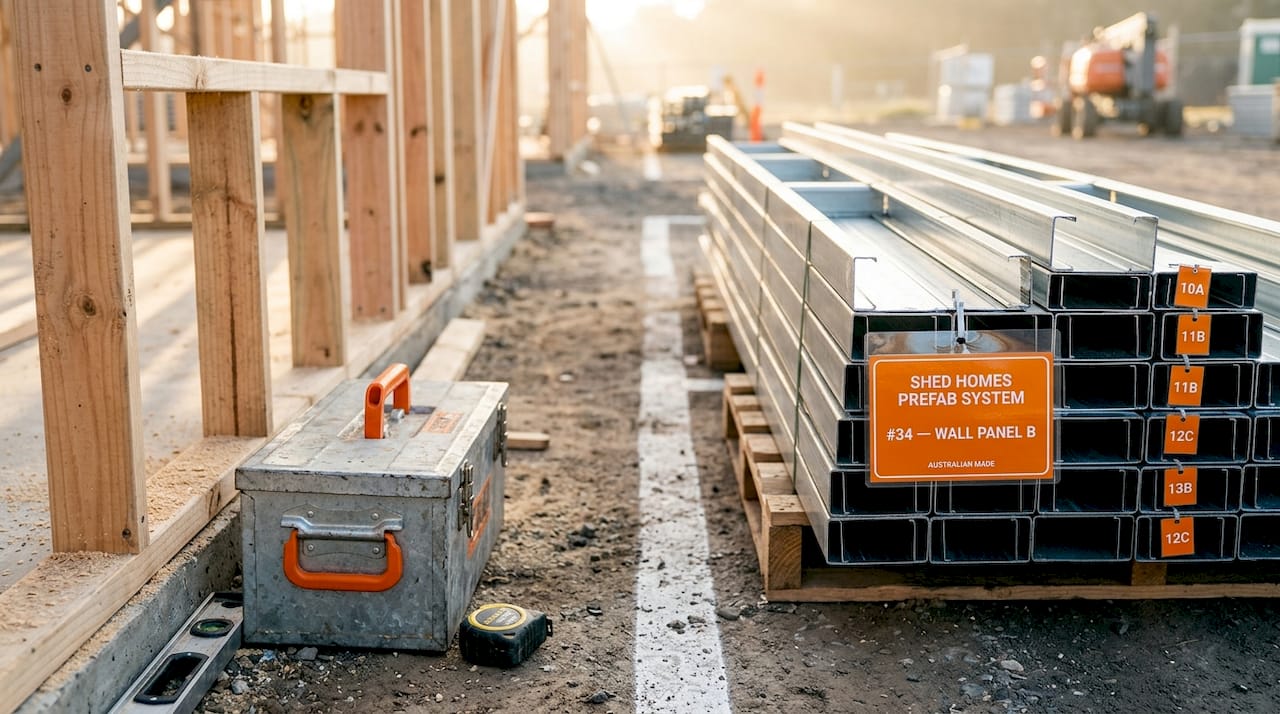
Engineering precision also reduces on-site uncertainty, keeping trades on schedule and avoiding the cascading delays that affect traditional builds. When the frame goes up in days rather than weeks, the roofing crew, window installers, and door suppliers can all be booked with confidence.
One scheduling factor that catches many owner-builders off guard is the distinction between kit lead time and erection speed. Lead times for steel kits typically range from eight to twenty weeks from order to delivery. Slab curing adds further time before erection can begin. The rapid lock-up window only opens once those upstream steps are complete, so realistic planning accounts for both.
- Prefabricated panels arrive numbered and sequenced for fast assembly
- Portal frames are pre-drilled and pre-welded to engineering specifications
- Roof sheeting, purlins, and girts are cut to length at the factory
- Erection drawings guide crews through a logical, step-by-step sequence
- No on-site cutting or measuring reduces waste and rework
Pro Tip: Lock in your roofing and window subcontractors before the steel kit arrives on site. With a one-to-two week erection window, trades that are not pre-booked will push your lock-up date out by weeks.
What does lock-up actually include in a shed home build?
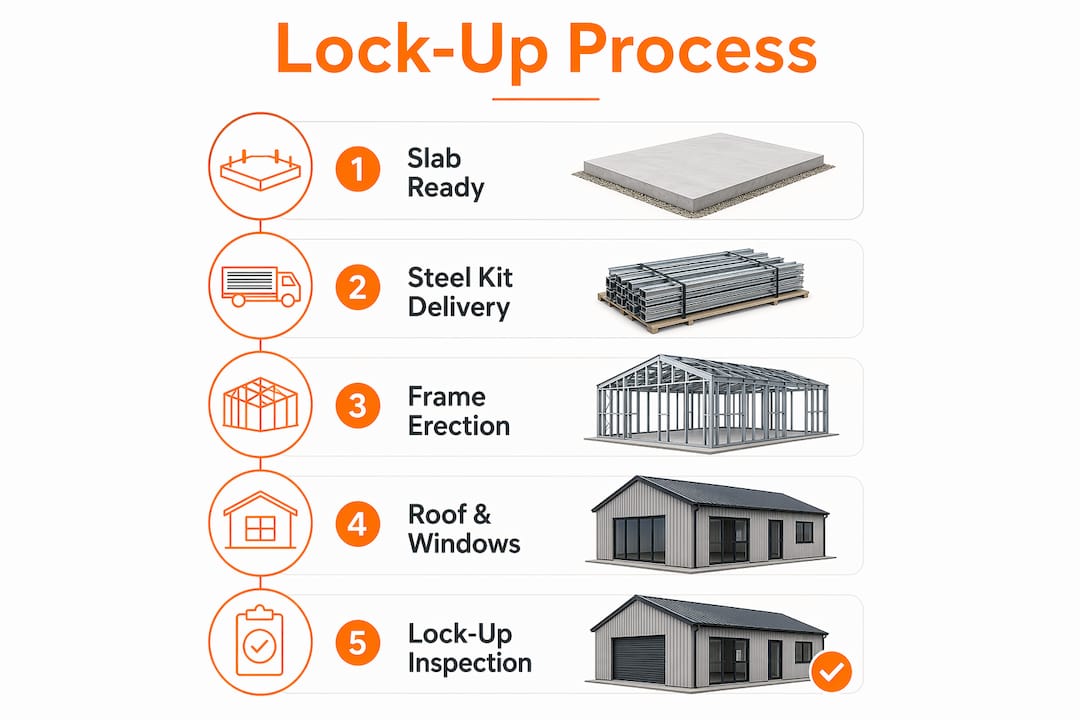
Lock-up is not achieved when the roof goes on. This is one of the most persistent misconceptions among owner-builders, and it costs time and money. True lock-up requires the full external envelope: walls, roof covering, sarking, flashings, ridge capping, plus all windows glazed and sealed, and all external doors fitted and lockable.
For a shed home, that envelope is more substantial than many people expect. The components that must be in place before lock-up is declared include:
- Roof covering installed over sarking with all flashings and ridge capping sealed
- External wall cladding fixed and weather-sealed at all joints and penetrations
- All windows glazed, sealed, and confirmed operational
- External doors fitted and lockable, including front entry, laundry, sliding, and garage doors where applicable
- Inspection and testing of every opening for draft leaks, light gaps, and lock function
The inspection step is not optional. Checking windows and doors for smooth operation, confirmed lock function, and the absence of draft or light leaks is the quality gate that separates a genuine lock-up from a frame with a roof on it. Internal fit-out materials, flooring, cabinetry, and electrical rough-in are all at risk if the shell is not genuinely weather-tight before work begins.
| Lock-up component | Why it matters |
|---|---|
| Roof covering with sarking | Prevents water ingress and provides thermal barrier |
| Flashings and ridge capping | Seals all roof penetrations against wind-driven rain |
| Glazed and sealed windows | Completes weather-tight envelope and provides security |
| Lockable external doors | Enables site security and confirms shell integrity |
| Draft and light leak inspection | Validates weather tightness before internal work begins |
The shed home build process at Shed-homes is structured so that all five components are addressed in sequence, with approval-ready documentation supporting each stage. This removes the guesswork that often delays lock-up sign-off on conventional builds.
How do shed home timelines compare with traditional builds?
The contrast between shed homes construction speed and conventional timber framing is stark when you examine it at the structural phase. Timber stick framing to lock-up typically takes eight to fourteen weeks on a standard residential project, accounting for frame erection, roof structure, window installation, and door fitting. Steel kit shell erection achieves the same milestone in roughly half that time.
| Build method | Frame to lock-up | Key risk factors |
|---|---|---|
| Timber stick frame | 8 to 14 weeks | Weather delays, on-site cutting errors, labour variability |
| Steel frame kit | 3 to 6 weeks | Lead time planning, slab cure scheduling |
The financial implications of that gap are real. Every week a build sits open to the elements is a week of potential weather damage to materials, a week of holding costs on land finance, and a week of delayed access for internal trades. Faster shell completion minimises rain damage risk and keeps the entire project schedule intact.
There is also a quality argument. Timber that sits exposed to rain during a slow framing process absorbs moisture, which creates long-term risks including warping, mould, and nail corrosion. Steel does not absorb moisture. A steel kit that reaches lock-up in two weeks has had minimal weather exposure, and the structure inside that envelope is in the same condition it left the factory.
Pro Tip: When comparing builder quotes, ask specifically how many weeks from slab pour to lock-up each method assumes. The answer will reveal more about project risk than the headline price.
What are the benefits of fast lock-up for Australian shed home owners?
The benefits of quick shed homes extend well beyond the satisfaction of watching a build move fast. Speed at the lock-up stage creates a cascade of practical advantages that affect cost, quality, and control throughout the rest of the project.
- Weather protection: A sealed shell means internal materials, flooring, cabinetry, and electrical components are delivered into a dry, secure environment rather than a construction site exposed to rain and UV.
- Trade scheduling certainty: Predictable construction schedules allow electricians, plumbers, and plasterers to be booked with confidence, reducing the idle time that inflates project costs.
- Reduced builder management costs: Owner-builders who reach lock-up quickly spend less time managing site security, weather protection, and material storage logistics.
- Owner-builder flexibility: Once lock-up is achieved, the internal fit-out can proceed at the owner’s pace. Many Shed-homes clients manage their own internal trades after lock-up, capturing significant cost savings.
- Code compliance confidence: Shed-homes kits carry integrated wind and fire ratings and are approval-ready, meaning the engineering documentation required for council sign-off is part of the package rather than an afterthought.
Pre-engineered shed structures with wind and fire ratings also enable faster compliance approvals, which shortens the period between development approval and construction start. For regional and rural builds in Queensland and New South Wales, where council timelines can be unpredictable, having approval-ready documentation is a material advantage.
The Class 1A classification that applies to habitable shed homes carries specific engineering and compliance requirements. Shed-homes kits are designed to meet those requirements from the outset, so there are no costly redesigns or certification delays at the lock-up inspection stage.
Bottom lines
Steel frame kit shed homes reach lock-up in three to six weeks because prefabrication eliminates on-site variability, and genuine lock-up requires a fully sealed envelope including all windows, doors, and cladding, not just a roof on a frame.
| Point | Details |
|---|---|
| Steel kit erection speed | A steel frame kit erects in one to two weeks after slab cure, versus four to six weeks for timber framing. |
| True lock-up definition | Lock-up requires glazed windows, lockable doors, and sealed cladding, not just a roof structure. |
| Lead time planning | Kit lead times of eight to twenty weeks must be factored into the overall project schedule. |
| Financial benefits | Faster lock-up reduces weather damage risk, holding costs, and trade scheduling delays. |
| Compliance advantage | Approval-ready kits with wind and fire ratings accelerate council sign-off and reduce certification risk. |
What builders consistently overlook about shed home lock-up
The question I hear most often from prospective owner-builders is some version of: “How fast can shed homes be built?” The honest answer is that the erection phase is genuinely fast. What surprises people is that the speed of the steel kit assembly is only one part of the equation.
The lock-up milestone is frequently misunderstood, even by people who have built before. I have seen owner-builders declare lock-up when the roof sheets are on and the frame is standing, only to discover weeks later that unsealed window reveals and a missing laundry door mean their internal fit-out materials have been sitting in a shell that is not actually weather-tight. The full external envelope is the standard, and anything short of that is not lock-up.
The other thing builders underestimate is the value of the steel kit’s precision beyond speed. When components are factory-engineered to tolerance, the inspection at lock-up is straightforward. Windows open and close correctly. Doors seal without adjustment. There are no gaps in the cladding because the panels were cut to fit. That precision translates directly into a cleaner, faster internal fit-out, because the shell you are working inside is square, plumb, and dry.
Speed is the headline. Certainty is the real product.
, Shed
Build with confidence: explore Shed-homes steel frame kits
Shed-homes supplies Australian-made steel frame kit homes engineered to reach lock-up in as little as three to six weeks. Every kit includes precision-fabricated components, detailed architectural specifications, and approval-ready documentation that simplifies council submissions. Designs range from curated layouts like the Tasman through to fully custom configurations, with clear, all-inclusive pricing that removes the cost uncertainty common in traditional builds. If you are weighing up your options for a fast, durable, and cost-effective home, the Shed-homes build process is a practical place to start.
FAQ
How fast can shed homes reach lock-up?
Shed homes using steel frame kits can reach lock-up in three to six weeks from the start of erection, with the steel frame itself typically erected in one to two weeks once the slab is cured and ready.
What does lock-up mean in a shed home build?
Lock-up means the building has a complete weather-tight envelope: external walls, roof covering with sarking and flashings, all windows glazed and sealed, and all external doors fitted and lockable.
Why is steel framing faster than timber for reaching lock-up?
Steel kit components are prefabricated to precise tolerances and arrive on site numbered and sequenced, eliminating the on-site measuring and cutting that slows timber framing. This reduces erection time from the four to six weeks typical of timber to one to two weeks for steel.
Do shed home kits include council approval documentation?
Shed-homes kits are approval-ready, meaning they include integrated engineering documentation, wind and fire ratings, and architectural specifications designed to satisfy Australian council requirements without additional certification work.
Is lock-up the same as frame completion?
No. Frame completion is an earlier milestone. Lock-up requires the full external envelope to be sealed and secured, including all cladding, glazed windows, and lockable doors, before it is recognised as a valid construction stage.
Recommended
- Shed House Australia, Steel Frame Kits | Shed Homes
- Shed Homes Blog | Insights, Guides and Build Advice
Ready to start planning your shed home?
Use our free Online Designer to design your layout, or send us an enquiry and we’ll get back to you with an obligation-free quote based on your site address.