

If you’re building a shed home on acreage, you’ve probably already pictured the verandah. Cold beer, dogs at your feet, watching the sun go down over your own paddock. That’s not just lifestyle marketing, it’s one of the main reasons people build shed homes in the first place. And the good news is, designing outdoor living into a steel kit home is straightforward if you plan it from the start.
How do shed home design features enhance outdoor living?
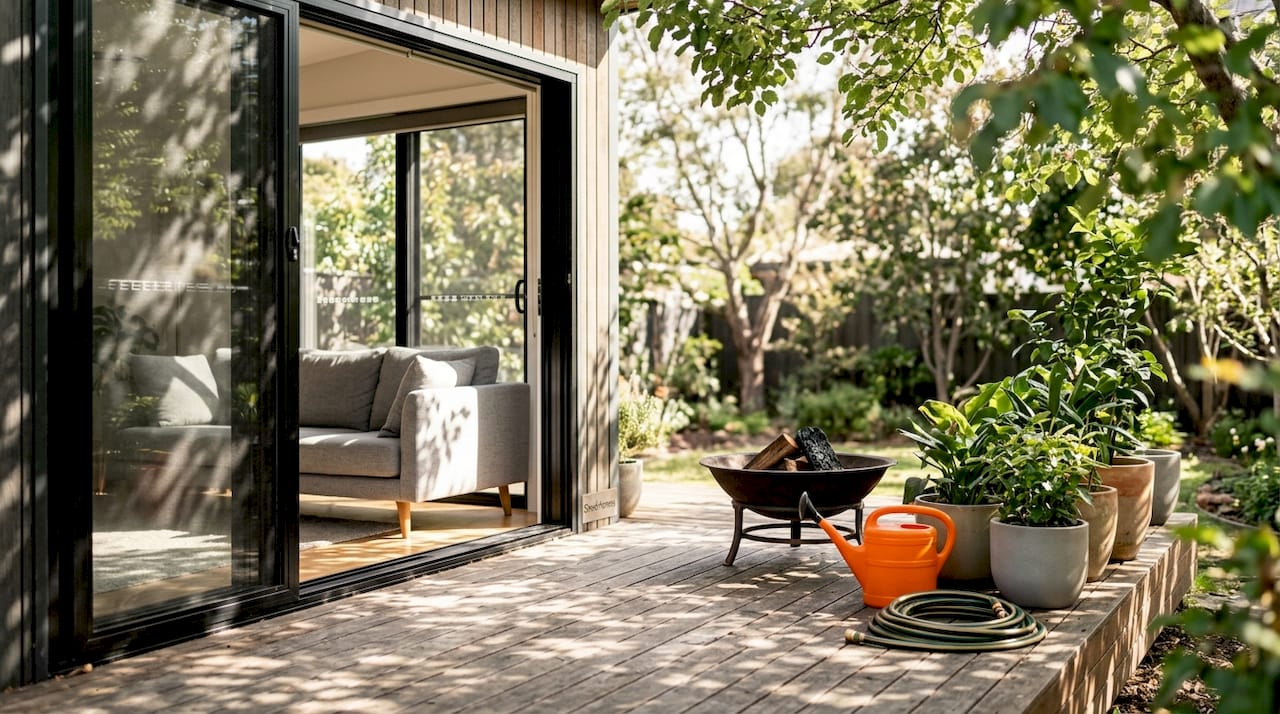
The physical connection between a shed home and its surrounding outdoor space begins at the threshold. A covered porch attached to a lofted shed creates a transitional zone that protects the doorway from rain and sun while providing casual seating for two to three people. Larger porches extend this function entirely, becoming outdoor rooms suited to entertaining. This is not decoration. It is a deliberate weather buffer that makes the transition between inside and outside repeatable in any season.
Beyond the porch, the following design elements define how shed homes and outdoor spaces work together as a unified system:
- Deck and pathway connections link the shed interior to garden zones, lawns, or vegetable beds without requiring occupants to work through uneven ground or exposed weather.
- Greenhouse-shed hybrids, such as the Alton Fusion cedar and glass design, use internal sliding doors so gardeners can move between potting benches and tool storage without stepping outside. This eliminates weather exposure during the most task-intensive moments.
- Outdoor seating and entertaining setups positioned adjacent to the shed entry extend the functional footprint of the home at minimal cost. A well-placed pergola or hardstand area effectively adds a room without adding a roof.
- Weather-resistant materials including Colorbond steel, treated timber decking, and UV-stable polycarbonate glazing maintain structural integrity and appearance across Australian climate zones.
- Exterior lighting on porches and pathways extends usability into evening hours, which matters for anyone using the shed as a workshop, studio, or garden room after work.
Pro Tip: Select lighting rated to IP44 or higher for any outdoor-connected shed area. This rating confirms the fitting is protected against water splashing from any direction, which is the minimum standard for covered but exposed Australian conditions.
The principle underlying all of these elements is adjacency. The closer the shed’s functional zones are to the outdoor activities they support, the less friction exists in daily use. A shed home designed with this logic becomes a natural extension of the garden, the workshop, and the entertaining area rather than a separate building you walk to.
What building systems make shed homes usable year-round?
A shed home connected to outdoor living is only as good as its internal comfort systems. Thermal performance, moisture control, and mechanical conditioning determine whether the space is genuinely livable or merely weatherproof. Getting the construction sequence right is as important as the specification itself.
The correct order of operations for a livable shed conversion is:
- Install vapour barrier and insulation first. Walls require a minimum of R-13 insulation; ceilings require R-19 for a standard 12 by 16 foot configuration. Insulating before electrical rough-in prevents the need to cut and patch later.
- Complete electrical rough-in second. Running conduit and cabling through insulated walls after the fact is expensive and disruptive. Plan power points, lighting circuits, and any sub-board requirements at this stage.
- Install electrical third. A 9000 BTU mini-split system provides adequate heating and cooling for a standard shed home footprint. Mini-splits are preferred because they require no ductwork and can be positioned to avoid thermal bridging through the wall framing.
- Lay flooring last. Flooring installed before electrical commissioning is exposed to construction moisture and temperature swings that cause warping, particularly in timber and laminate products.
- Commission ventilation and exhaust independently. A dedicated exhaust fan in bathrooms or kitchenettes, combined with vapour barrier planning at the wall and ceiling junctions, prevents the condensation buildup that causes mould and structural damage over time.
Thermal performance benchmarks from SIP-based garden room designs, such as the Hyggehut, show that U-values as low as 0.13 W/m²K are achievable in well-insulated shed structures. That figure is comparable to a modern double-brick home. It means a properly built shed home does not ask you to choose between outdoor connection and indoor comfort.
Pro Tip: Never install flooring before the electrical system has run for at least one full heating and cooling cycle. The thermal movement in a new shed structure is significant, and flooring laid too early will gap, buckle, or delaminate within the first year.
How do building codes affect shed and outdoor space integration?
Regulatory requirements are the most underestimated variable in shed home and outdoor living projects. The rules governing size, utility connections, and habitable use directly determine what you can build, where you can build it, and how it must be connected to services.
The table below summarises permit requirements by shed type and size to provide practical context:
| Shed type | Size threshold | Permit required? | Zoning applies? |
|---|---|---|---|
| Storage shed | Under 256 sq ft (approx. 24 m²) | No building permit (Virginia example) | Yes, always |
| Storage shed | Over 256 sq ft | Yes, building permit required | Yes |
| Habitable shed home (Class 1A) | Any size | Yes, full building and electrical compliance | Yes |
| Greenhouse-shed hybrid | Depends on utility connections | Likely yes if plumbing or power added | Yes |
| Shed with porch or deck | Deck area may trigger separate permit | Varies by council | Yes |
Virginia’s rule that sheds under 256 sq ft are exempt from building permits is a useful reference point, but zoning setbacks still apply regardless of size. In Australia, the equivalent threshold varies by state and local council. The practical implication is that a shed home with a connected porch, deck, or utility service will almost always require council approval, regardless of footprint.
Spokane’s municipal code illustrates a stricter standard: habitable sheds require connection to municipal utilities and full compliance with building, electrical, and plumbing codes. HOA restrictions add another layer, sometimes prohibiting visible outbuildings or limiting roof pitch and cladding materials. The lesson is direct. Confirm your zoning classification, setback requirements, and utility access before committing to a design. A feasibility review at the concept stage costs a fraction of what a redesign costs after approval is refused.
What are the lifestyle and sustainability benefits of connected shed homes?
The case for integrating sheds into outdoor living landscapes is not purely aesthetic. It is financial, functional, and environmental. Architecture professor Anthony Burke describes small outdoor areas of approximately 2 metres by 4 metres as capable of significantly improving home usability when treated as casual, affordable extensions rather than formal additions. A connected shed home operates on the same principle at a larger scale.
The practical benefits are measurable:
- Centralised storage reduces the time spent locating seasonal tools and gear. A well-organised shed keeps winter equipment, garden tools, and outdoor furniture accessible without searching through a garage or multiple storage points.
- Year-round outdoor routines become sustainable when the shed provides a weather-protected base for seasonal tasks. Potting, woodworking, and equipment maintenance continue through winter when there is a conditioned space to work from.
- Casual flow between indoor and outdoor zones encourages more frequent use of the property. When the path from kitchen to garden shed is covered and level, people use it. When it requires working through wet grass in the dark, they do not.
- Reduced construction cost per square metre compared to a full home extension. A connected shed home adds functional space at a fraction of the cost of a traditional addition, particularly when using a precision-engineered steel kit.
“Small outdoor areas significantly improve home usability as casual, affordable extensions.”, Architecture professor Anthony Burke, as cited by ABC News, 2026.
The sustainability argument is equally direct. Steel frame shed homes use less material than timber-framed equivalents, are recyclable at end of life, and can be designed to achieve strong NatHERS energy ratings when insulation and glazing are specified correctly. The outdoor lifestyle benefits compound when the structure itself is built to last rather than to be replaced.
What layout principles optimise shed homes for outdoor lifestyles?
Layout is where good intentions either succeed or fail. A shed home that looks connected on a plan but requires occupants to walk outside between every functional zone has not solved the problem. It has relocated it.
The Alton Fusion design principle is instructive here. By connecting a greenhouse and a storage shed with internal sliding doors, the design eliminates outdoor transit during garden tasks entirely. The workbench, the tool storage, and the growing area share a single weather-protected envelope. That is the standard to apply to any shed home and outdoor living integration.
Practical layout principles that support this outcome include:
- Zone adjacency planning. Place the shed’s primary function, whether workshop, studio, or utility room, directly adjacent to the outdoor activity it supports. A potting shed belongs next to the vegetable garden. A workshop belongs near the materials storage area.
- Covered transition paths. A roofed walkway or pergola connecting the shed to the main dwelling removes the weather variable from daily movement. This is particularly relevant in Queensland and northern Australia where afternoon storms are routine.
- Mudroom or buffer entry. A small entry zone inside the shed door, fitted with hooks, a boot rack, and a utility sink, prevents outdoor mess from entering the living area. This is the indoor-outdoor weather buffer concept applied at the micro scale.
- Utility coordination early. Power, water, and data connections to a shed home must be planned before the slab is poured. Conduit sleeves through the slab cost almost nothing at the time of pour and thousands to retrofit later.
Pro Tip: Commission a feasibility review that covers zoning, utility access, and council permit requirements before finalising your shed home layout. Early identification of permitting and utility constraints prevents the most expensive redesigns.
Bottom lines
Shed homes connect to outdoor living through deliberate design, correct construction sequencing, and early regulatory compliance, not by accident.
| Point | Details |
|---|---|
| Design drives connection | Covered porches, internal sliding doors, and deck links physically unite shed homes with outdoor zones. |
| Construction sequence matters | Insulate before electrical, install electrical before flooring, and commission ventilation independently to avoid costly rework. |
| Codes apply regardless of size | Zoning setbacks and utility requirements affect all shed home projects; habitable use always triggers full compliance. |
| Lifestyle value is measurable | Centralised storage and casual outdoor flow reduce friction and extend year-round property use. |
| Plan feasibility first | Early zoning and utility reviews prevent redesigns and protect your investment before construction begins. |
What I have learned from building outdoor-connected shed homes
The projects that work best share one characteristic: the owner treated the outdoor connection as a structural decision, not a landscaping decision. They resolved the covered entry, the utility routing, and the zone adjacency on paper before a single post was set. The projects that struggled almost always skipped the feasibility review and discovered mid-build that the power connection required a trench through a neighbour’s easement, or that the deck triggered a separate permit that delayed occupation by four months.
Insulation failures are the second most common issue I observe. Builders who install flooring before the electrical system is commissioned create problems that take years to surface. Moisture migrates through an unsealed slab, the flooring lifts, and the occupant spends the first summer wondering why the space feels damp despite the air conditioning running constantly. The fix is straightforward in theory and expensive in practice.
The most satisfying shed home and outdoor living integrations I have seen are not the largest or the most expensive. They are the ones where a 2-metre covered porch connects directly to a garden workbench, where the lighting is on a timer, and where the owner uses the space every single day. That daily use is the real measure of success. A shed home that sits unused because it is uncomfortable, poorly lit, or awkward to reach from the main dwelling has failed its purpose regardless of how well it was built.
Prioritise planning. Prioritise the construction sequence. And treat the outdoor connection as the primary design constraint, not an afterthought.
, Shed
Build your outdoor-connected shed home with Shed-homes
Shed-homes supplies Australian-made steel frame kit homes engineered to Class 1A standard, with precision architectural plans included from the start. Every kit comes with detailed specifications that simplify council approval, removing the uncertainty that delays most owner-builder projects. Designs like the Kakadu and Tasman are built for properties where indoor-outdoor connection is the priority, with layouts that accommodate covered entries, deck connections, and utility routing from the ground up. If you are ready to move from concept to approved plans, the build process and approval-ready kits at Shed-homes give you a clear, costed path forward without the surprises.
FAQ
What makes a shed home different from a standard shed?
A shed home is classified as a Class 1A habitable dwelling and must comply with full building, electrical, and plumbing codes. A standard shed is a Class 10a non-habitable structure with significantly fewer regulatory requirements.
Do I need a permit to connect a deck or porch to a shed home?
Yes, in most Australian councils a deck or porch attached to a habitable structure requires a building permit. Zoning setbacks apply regardless of the deck size, so confirm requirements with your local council before construction.
What insulation values does a livable shed home need?
A minimum of R-13 insulation in walls and R-19 in ceilings is the standard specification for a 12 by 16 foot shed home footprint. Vapour barriers and air sealing at junctions are equally important for moisture control and thermal performance.
How does a greenhouse-shed hybrid improve outdoor living?
A greenhouse-shed hybrid uses internal sliding doors to connect growing and storage zones without requiring outdoor transit. This design eliminates weather exposure during garden tasks and is the most efficient layout for garden-focused outdoor lifestyles.
Can a shed home achieve a strong NatHERS energy rating?
Yes. When insulation, double glazing, and electrical are specified correctly, a steel frame shed home can achieve NatHERS ratings comparable to a conventionally built dwelling. Early design decisions on orientation and thermal mass have the greatest impact on the final rating.
Recommended
Ready to start planning your shed home?
Use our free Online Designer to design your layout, or send us an enquiry and we’ll get back to you with an obligation-free quote based on your site address.