Why asset-rich Australians are choosing Class 1A shouses as a deliberate financial strategy. Engineering, investment resilience, and lifestyle, the full case explained.
The word “shouse” doesn’t sound like a serious financial decision.
It sounds like something you’d cobble together from leftover corrugated iron and a prayer. Rough around the edges. A man cave at best. A weekender at worst.
But that’s precisely the tension worth unpacking.
Because while the name raises eyebrows, the economics are turning heads. Asset-rich Australians – people selling the family home, cashing out decades of equity, and deliberately considering what comes next are increasingly choosing Class 1A steel kit homes not just as a lifestyle move but as a calculated financial strategy.
This isn’t a trend for people who want a big garage. There is genuine economic engineering behind the structural engineering.
Here’s the full case, broken into four pillars: engineering, economic resilience, investment performance, and lifestyle.
Pillar 1: Engineering: This is Not a Garden Shed
The single most important thing to understand before you go any further is what “Class 1A” actually means because this is where most people get caught out.
Walk into any rural supplies store or browse any online kit supplier, and you’ll find sheds at prices that look incredibly tempting. Most of them are Class 10A structures. Non-habitable. They don’t need to be waterproofed to a residential standard. They don’t require insulation. You cannot legally sleep in them.
If you put a bed in a Class 10A shed and call it home, you are breaking the law, and you’ll be uncomfortable while doing it.
Class 1A is a different category entirely. It must meet the exact same National Construction Code requirements as any brick home in any suburb in the country, the same waterproofing standards, the same structural integrity requirements, the same fire and safety provisions, and the same energy efficiency benchmarks.
At Shed Homes, every kit we supply is Class 1A. That is a non-negotiable starting point. Not an upgrade to the baseline.
Why the material matters
Not all steel is equal, and this is where budget kit-home buyers learn a very expensive lesson.
Our kits use premium BlueScope steel with a zinc-aluminium alloy coating. This isn’t standard galvanisation, it’s a more advanced process that creates a barrier with a degree of self-healing capability. Where a scratch occurs, the zinc sacrifices itself electrochemically to protect the steel core beneath it.
Why site-specific engineering matters more than you think
Australia has some of the most diverse wind environments on earth. Cyclonic zones in the north. Exposed ridge tops. Shielded valleys. High-reactivity clay soils that move with moisture. Flood overlays. BAL zones in bushfire-prone areas.
A generic kit home is designed for the average person. Your block probably isn’t average.
Every Shed Homes kit is engineered to your specific site address. That means an engineer has calculated the actual stress loads for your actual terrain. That’s what turns a steel structure from a product into a certified, documented, insurable asset.
Pillar 2: Economic Resilience: The Inflation Hedge Most People Miss
Real estate 101 tells us land appreciates and buildings depreciate. So how does a steel structure hold its value in a shifting economy?
The answer sits in commodity markets.
When inflation drives up the cost of raw steel, as we saw sharply in 2021–2023, the replacement cost of an existing steel structure rises in proportion. You effectively own a stockpile of a commodity that happens to be precision-engineered and bolted to the ground.
The second layer of resilience is leverage, or more precisely, the absence of it.
A Class 1A shouse on owned acreage, built for half the cost per square metre of a comparable traditional build, means you’re either mortgage-free or carrying a fraction of the debt a conventional build would require.
Smart investors don’t just chase the highest peak. They focus on avoiding the deepest valley.
Pillar 3: Investment Performance: Capital Efficiency Over Speculation
The buyer this argument speaks to isn’t a first-home buyer. It’s someone who has already won that game.
A couple in their late 50s. Selling the family home. Buying acreage. Looking at what to build.
The formula:
- Kit price = steel frame, cladding, windows, doors, certified drawings and engineering
- Kit × 2 = approximate cost to lockup
- Kit × 3 = approximate owner-builder total
- Kit × 4 = approximate full builder total
Compared to a traditional build of the same footprint, the savings at each level are significant. That delta is preserved capital.
Pillar 4: Lifestyle – Downsizing the Cost, Not the Life
The standard downsize means moving to a smaller unit, losing the garage and the garden, and hearing the neighbours. For people who’ve spent 30 years building a life with space that’s not downsizing. That’s surrender.
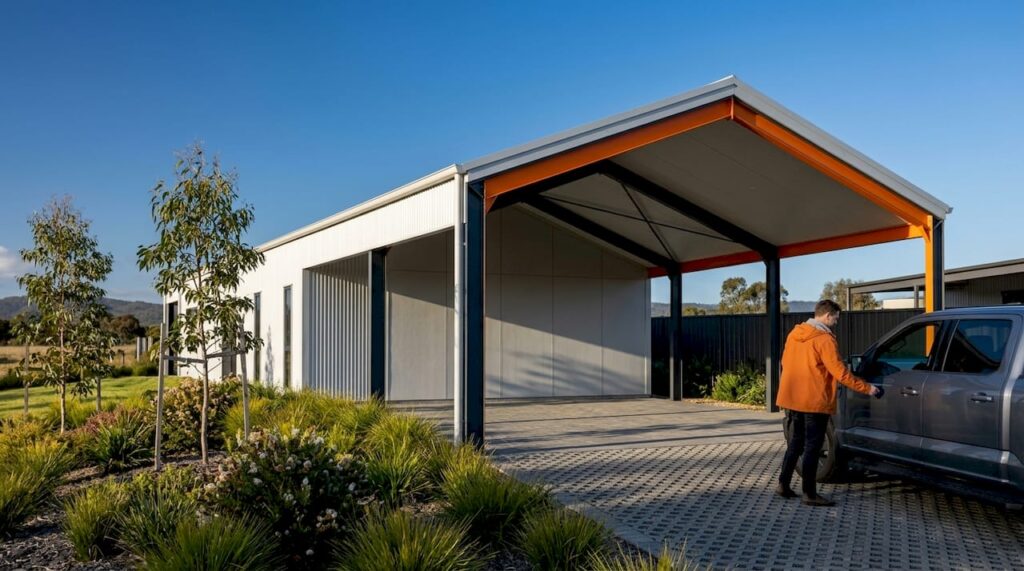
A Class 1A shouse built on portal-frame engineering gives you clear spans. No load-bearing internal walls. Living rooms 8–12 metres wide. Ceiling heights of 3.5–5 metres. Workshop, garage, and living space under the same engineered roof.
A properly engineered Class 1A shouse routinely achieves 7-star energy ratings better than most new brick homes.
You aren’t downsizing your life. You’re downsizing the cost of the container it’s in.
Is This the Right Move for You?
A Shed Homes Class 1A kit is built for people who:
- Own land or are in the process of buying it
- Have equity or capital available
- Are comfortable managing their own building approval process
- Want to build at their own pace, on their own terms
- Understand the difference between Class 1A and Class 10A
Start your enquiry here. Brian reviews every enquiry personally.
Related Reading
- Class 1a vs Class 10a Shed Homes Explained
- How Much Does a Shed Home Cost in Australia?
- Explore Our Shed Home Designs